What does the biggest day of Intelliflo announcements in its history, mean for you?
As by far the largest provider of advice tech to the wealth advice market, when intelliflo does something it has major implications across the industry. Today’s announcements will not just affect the adviser market but every platform, model portfolio provider and asset manager that works with them. Also of course the rest of the advicetech community. So, if you want the detail of what was announced by Intelliflo this morning, this is where to get it.
Let me warn you up front, it is a long read, but nonetheless an essential one for anyone working in the UK financial advice market because our industry runs on technology and more runs on intelliflo technology than anyone else.
A Platform Repositioned
Nick Eatock opened this year’s Innovate with a familiar message delivered with unusual force. Demand for advice has never been higher. Advisers have never been under more pressure. His answer, and the theme that ran through the whole plenary, is that the response from technology suppliers needs to be architectural, not incremental.
The centrepiece was the announcement, made by Eatock together with Akeel Ahmed, of intelliflo Office: Next Generation. This is a rebuilt platform organised around three commitments: customisable, intuitive and intelligent. The third is the one that matters most. intelliflo says it is building the agentic open platform for financial advice. Software that acts, rather than software that waits to be asked.
That phrase will appear in a great deal of marketing over the next year, and not only from intelliflo. What makes this version worth detailed attention is the engineering underneath it, which the company set out in more depth than these events usually offer. I will come to that below. First, the context.
The efficiency picture: real progress, persistent friction
intelliflo’s 2026 Advice Efficiency Survey shows a profession in the middle of a transformation. AI adoption among advice firms has jumped from 43% to 74% in a single year. That is a remarkable rate of change for a sector that has historically been cautious with new technology. Encouragingly, the time advisers spend face to face with clients has risen too, from 46% of working time in 2025 to 56% in 2026. On this evidence the technology is giving time back rather than absorbing it.
The friction has not gone away. 68% of firms still wrestle with manual data entry. 30% spend more than three hours producing a suitability report. 62% want fully digital workflows but do not yet have them. And two thirds of advisers say they would serve more clients if they had more time. That last figure is the one firm owners should dwell on. The constraint on growth is capacity, not demand.
intelliflo also presented its eAdviser Index, which tracks firms across four technology adoption cohorts: Explorers, Adopters, Embracers and Champions. The gap between the top and bottom of that ladder is stark. Champions achieve 148% more clients per adviser, 234% more assets under advice and 119% more recurring revenue than Explorers.
These are striking numbers. They are also intelliflo’s own, drawn from its user base, and the usual caveats apply. Firms that are growing may adopt more technology because they are growing, rather than the other way round. Even allowing for that, the size of the gap supports a conclusion we have reached repeatedly in our own research at FTRC: the value sits in deep adoption, not in ownership.

Nick Eatock, intelliflo CEO

Akeel Ahmed, intelliflo CTO
Delivery record: a promise kept matters more than a promise made
Before turning to the roadmap, one number deserves attention. intelliflo reported that it has delivered ten of the eleven enhancements announced at last year’s event, and expanded two of them, Wealthlink and IQ Engagement, beyond their original scope in response to customer feedback. The eleventh, IQ Advice Assistant, is due later in 2026. The company also credits the Carlyle acquisition with adding scale and speed to its delivery capability.
This matters. Conference roadmaps are cheap, and anyone who has covered this industry for long enough has seen suppliers announce the same feature three years running. A ten out of eleven delivery record earns intelliflo the right to be taken seriously on what follows.
What is live now
Four capabilities anchor the current platform and were positioned as the foundation everything else builds on.
- IQ Engagement Assistant. AI that records and transcribes client meetings in real time, captures goals automatically and generates compliant records. The adviser stays present in the conversation instead of taking notes.
- Post-meeting administration. IQ processes data updates from photo uploads and voice files and produces personalised client documents in minutes. Advisers review and approve with a few clicks. There is no manual re-keying.
- Tasks and Workflows. Rebuilt from the ground up on customer feedback. Priorities surface automatically on the Home Dashboard, mandatory checklists are enforced and outcome-triggered processes advance on their own, removing the need for staff to chase cases through the system.
- Wealthlink. Based on analysis conducted by IFA Outsourcing, intelliflo’s platform integration reduces what was 32 minutes of system switching, re-keying and signature chasing to 8 minutes, with direct account opening and real-time servicing across GIAs, ISAs and SIPPs. intelliflo’s arithmetic is that for every 100 clients this recovers 40 hours, a full working week returned to advice. Re-keying between back office and platform remains one of the most expensive habits in UK advice and eliminating it in this way is really valuable.
The Roadmap: Six capabilities in seven months
intelliflo set out six major deliveries through the rest of 2026 and into the first quarter of 2027.
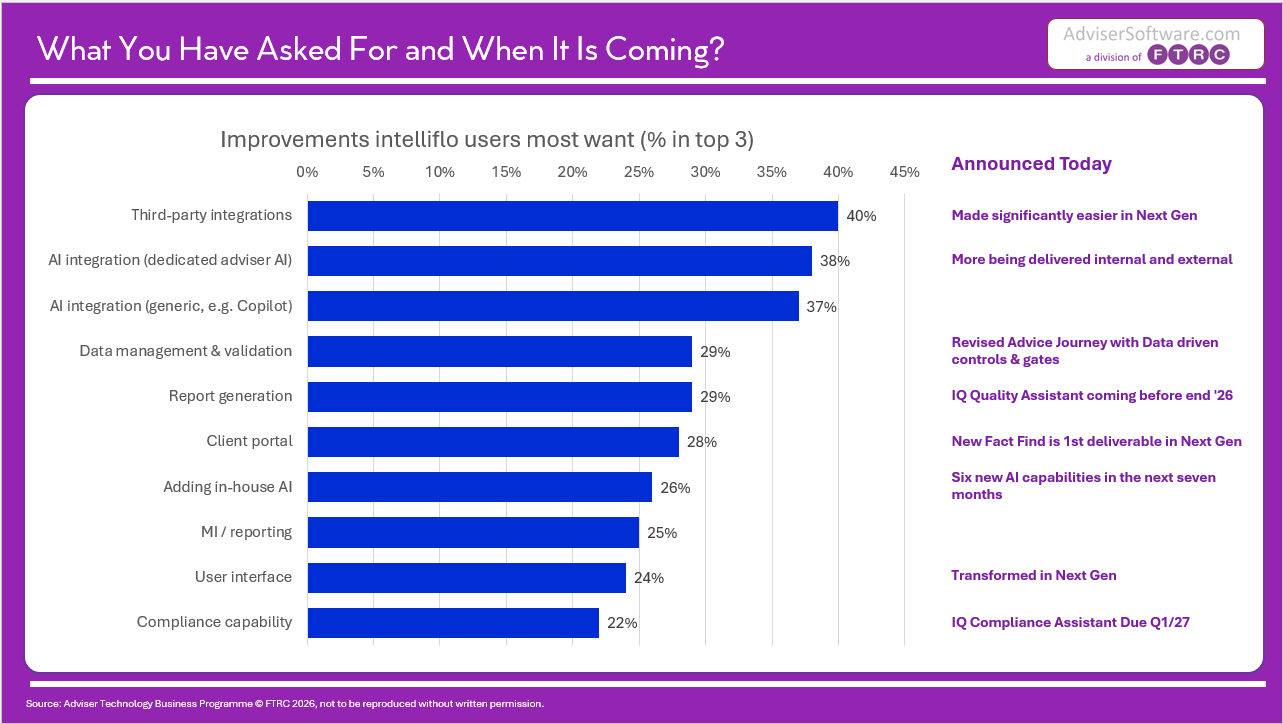
IQ Advice Assistant (later in 2026). A proactive financial planning tool that monitors real-time data to detect changes in client circumstances or goals, performs financial health checks and recommends suitable, timely advice based on the firm’s own advice guidelines. This is the last of last year’s eleven commitments and arguably the most ambitious. Done well, it turns the client bank from a static book into something the system actively watches on the adviser’s behalf.

IQ Quality Assistant (end of 2026). Described as constantly scanning for issues before they become problems, it operates across four areas:
- Suitability reports. Before a report goes out, IQ catches gaps, overstatements and unsupported conclusions, verifying against FCA requirements and firm policies in seconds.
- Presentation meetings. IQ checks that risks, costs and trade-offs were covered, flags conduct risks early and provides evidence of discussions, turning conversations into compliance safeguards.
- Fact finds. IQ checks the fact find was thorough, that the adviser has not drifted into premature advice and that things were explained clearly.
- Consumer Duty. IQ strengthens evidence of good outcomes and client understanding, and highlights where complexity might mismatch client capacity.
IQ Compliance Assistant (Q1 2027). Compliance oversight at firm level, on two dimensions. Issue detection and remediation spots gaps in evidence and weak justifications faster than manual review. Supervisory oversight aggregates assessments across the firm to find patterns by adviser, product or theme, and generates SMCR and FCA reporting. intelliflo’s pitch is blunt: spot issues before the regulator does.
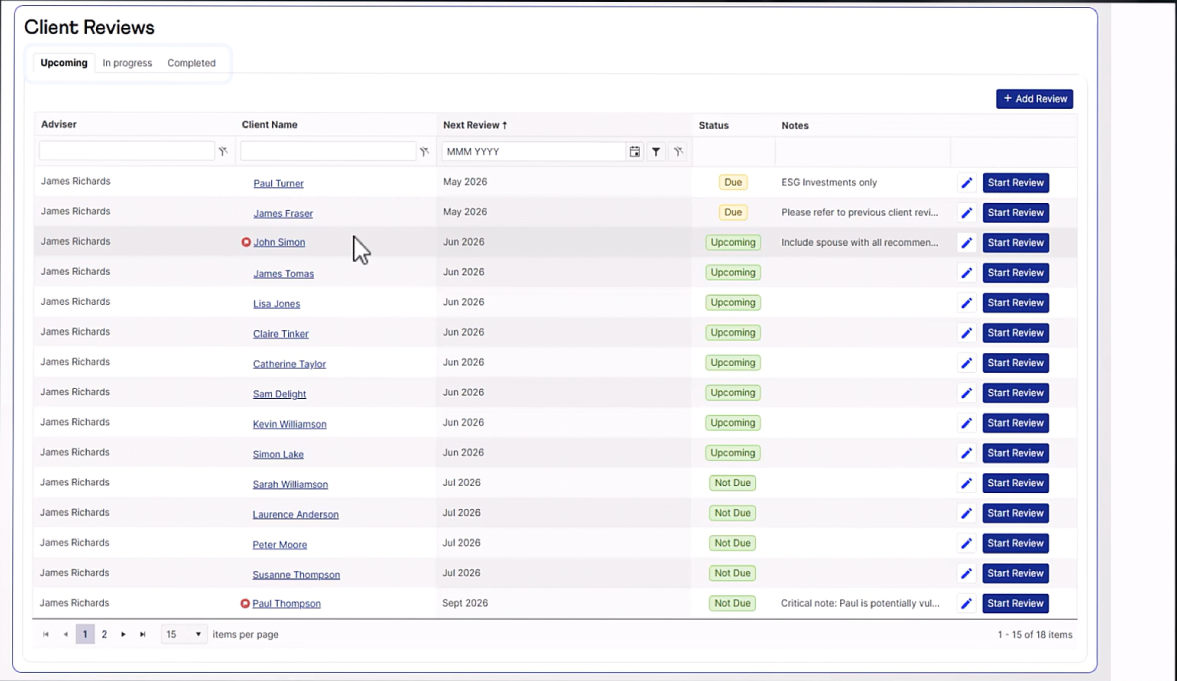
Client Reviews redesigned (end of 2026). A new Reviews section provides comprehensive client scheduling with RAG-status due dates and vulnerability flags. Clients get a completely redesigned fact find within the Personal Finance Portal, built to be intuitive and unobtrusive, so they can prepare ahead of reviews at their own convenience.
Flo 2.0 and agentic AI. Flo is a personal AI assistant inside intelliflo Office. Rather than just answering questions, Flo proactively surfaces what the adviser needs, prepares documents, updates records and completes tasks. Set direction once and the system handles the rest. intelliflo frames this as the shift from software that assists to software that acts.
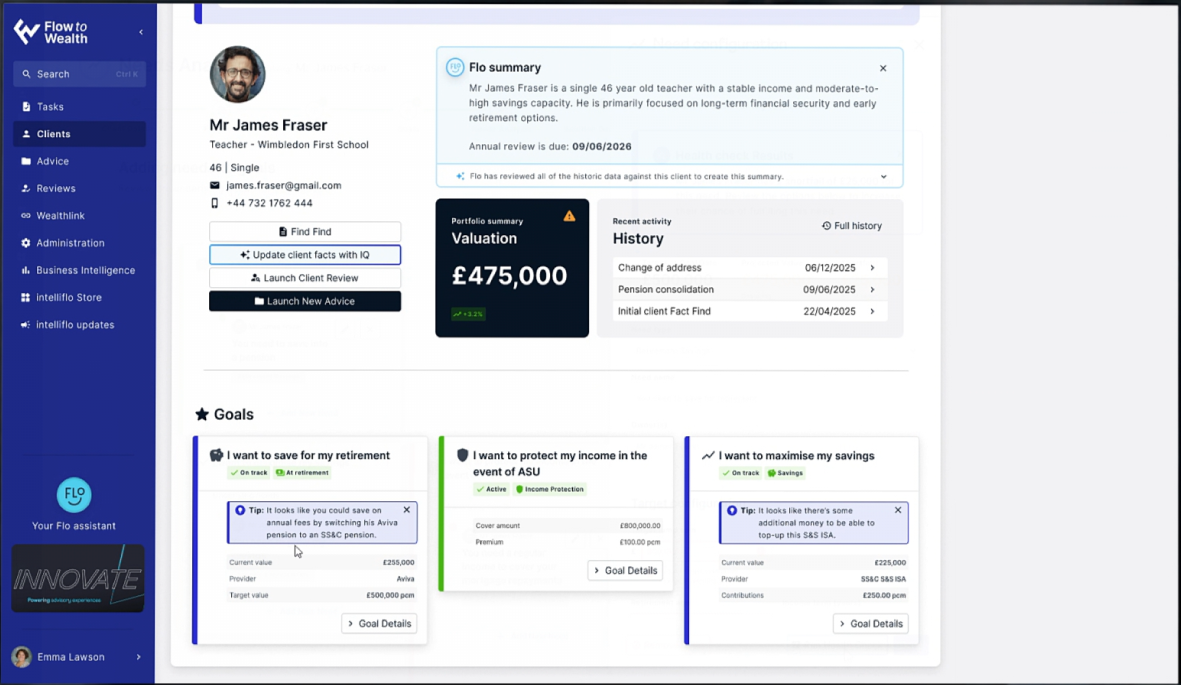
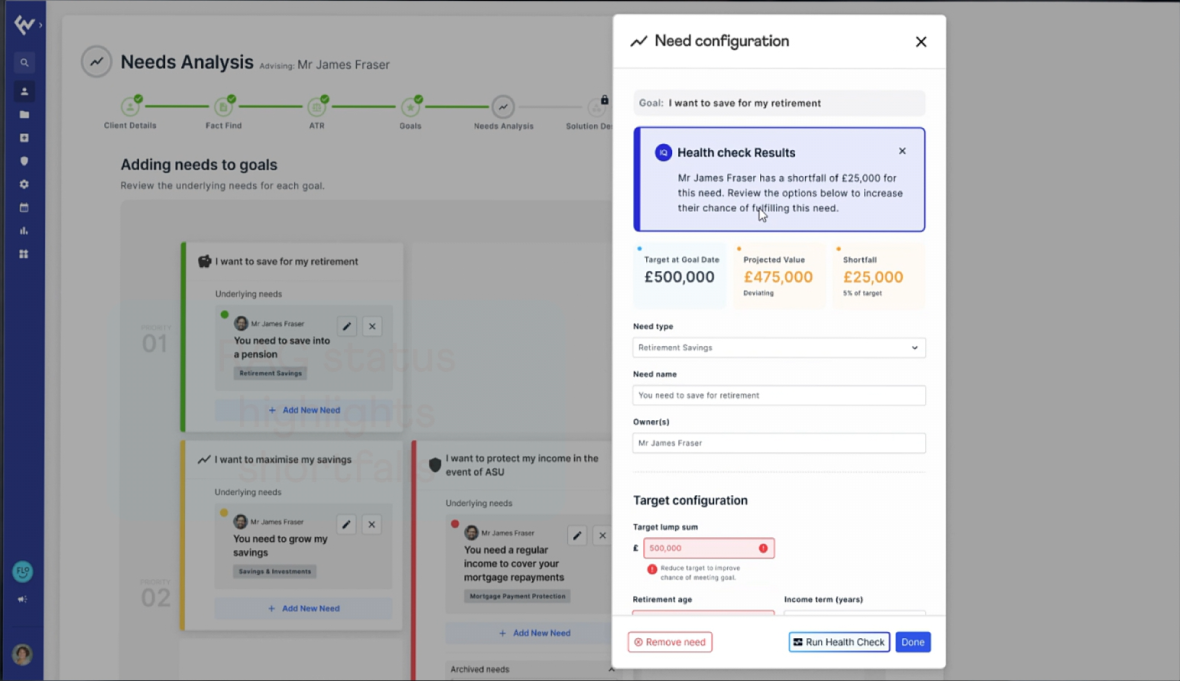
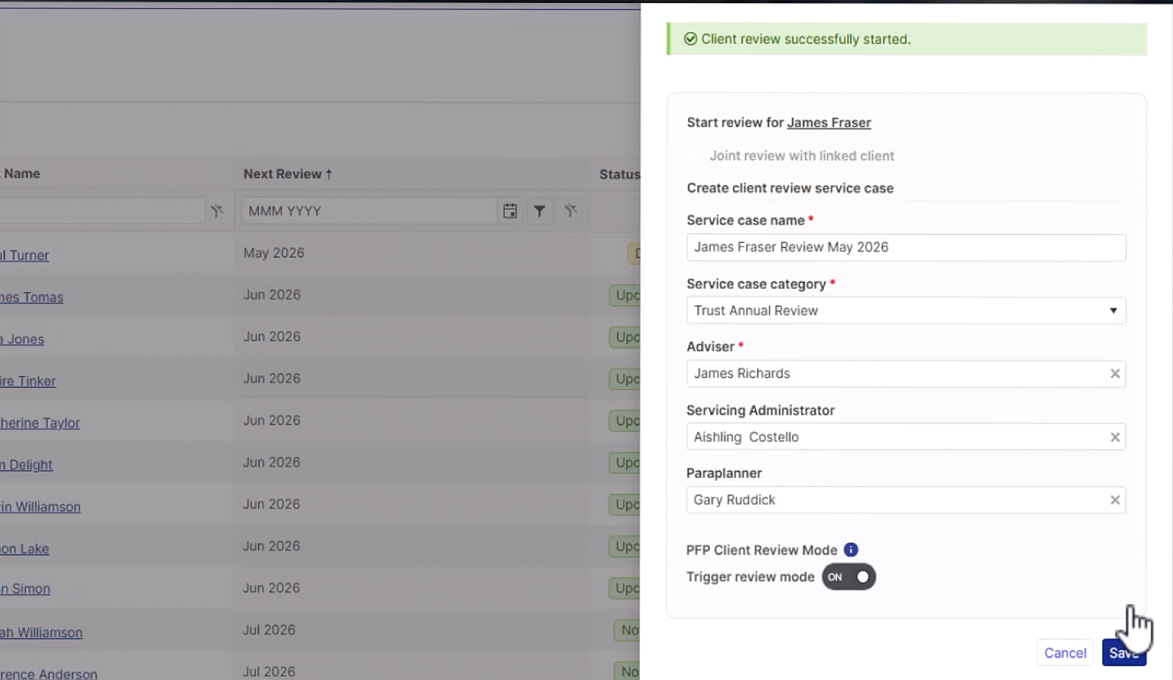
Revised Advice Journey. Advice journeys become rules-based and aligned to the firm’s own suitability guidelines, with client goals at the centre. Data-driven controls and gates, including fact-find completion and document checks, are built in. If a case flags, the journey pauses for end-to-end checking with dynamic checklists and clear remediation steps. Cashflow modelling underpins the whole journey, and clients see before-and-after scenarios rather than a bare recommendation, giving them the reasoning and the impact behind the advice.
Taken together, the IQ suite amounts to embedding the compliance function into the advice process itself rather than running it afterwards. If the assistants perform as described, the gain is not just speed. It is consistency of evidence, which is exactly what Consumer Duty supervision keeps asking for. The proof will be in false-positive rates and in how well firm-specific policies can be encoded. Neither was demonstrated in detail, so judgement on both should be reserved until firms can test the tools themselves.
intelliflo Flow to Wealth videos
The centrepiece: intelliflo Office Next Generation
The new platform rests on three pillars.
Customisable: the system holds your shape
Firms will be able to hide unwanted fields, reorder sections and add custom fields with minimal setup, with every custom field immediately available via API. Two technologies underpin this. intelliflo.Fields provides user-definable fields that can be added to any form and governed centrally. Fields are tenanted, inheritable and structured, behaving as native parts of the platform rather than bolt-ons. intelliflo.Forms is a configurable interface layer that lets firms compose, arrange and branch the user interface from a global baseline, adjusting flow, language and structure to reflect their own proposition.
The first deployment is the client fact find, and the reasoning is sound. Every firm has a wish list for the fact find. It is the highest-frequency client touchpoint, so configurability pays back faster there than anywhere else in the journey. And it is where a client first feels what kind of firm they are dealing with. intelliflo described the tension it hears most from clients: principals fear losing what makes them distinctive on standard software, while IT teams fear ending up with a system that is all bespoke and no backbone. A standard baseline underneath with firm identity on top is a sensible resolution, provided the governance holds.
The API estate has already grown from 228 to more than 340 endpoints over the last year and will continue to grow. More significant than the count is the change in kind, from field-level updates to intent-based actions, where firms define what they want to achieve and the platform handles the logic. More on that below.
Intuitive: clarity as a feature
The second pillar is a complete redesign built around how advice professionals actually think and work. Key actions are obvious, information is easier to find and the interface is calmer. intelliflo argues that clarity compounds, with seconds and errors saved across thousands of daily interactions. That is true, but redesigns of heavily used systems are also disruptive in the short term. Retraining costs are real, and firms will want detail on how the transition is managed before they cheer.
Intelligent: the agentic open platform
This is the big shift. Today’s advice technology is fragmented, with practice management, cashflow modelling, reporting and client portal tools operating separately. intelliflo wants to be the agentic open platform that orchestrates across all of it. The platform scans data continuously for anomalies, prepares advisers ahead of client reviews and surfaces decisions that need to be made, without being prompted. The move is from logging in to do something, to software working in the background to help you do your job better.
Crucially, intelliflo says it is building this openly, so third-party suppliers can use the same capabilities. That single decision will determine whether this becomes an ecosystem play or a walled garden, and it is the right call.
Under the bonnet: from APIs to operations
This was the most substantial part of the technical briefing, and the part with the longest-term consequences.
Today, processing a single client contribution through intelliflo’s REST API takes six sequential calls. The developer assembles the integration, manages the sequence and owns the failure handling. The new operational layer replaces that sequence with a single expression of intent: process this client’s contribution. One call. An auditable outcome. Orchestration handled by the platform. The REST API remains fully available for developers who need granular control. The operational layer sits above it for those who want outcomes rather than assembly.
The layer is branded intelliflo.Agent, described as the platform that turns operations into tools. It is built on four design properties. Tools are intent-focused, named by what they do for the firm rather than how they are wired. Each operation is value-oriented, mapping to a step the business already cares about. The interface is universally callable, so humans, internal AI and external agents all use the same one. And the unit of integration is the outcome, not the call.
Operations are composed into auditable flows called Playbooks, and every playbook runs in one of two execution models. Deterministic means a fixed sequence with a full evidence trail. The same input produces the same output every time, and each step is logged, signed and replayable. This is the compliance default. Non-deterministic means reasoned execution across the same underlying operations, with the agent adapting to context, exceptions and scale. This is the efficiency default. The choice of execution model is made per process and remains with the firm.
On top of this sit three modes of AI operation, again set per process. In Mode 1, co-pilot, the AI suggests and the human decides. In Mode 2, supervised agent, the AI proposes and executes within bounds, but a human approves before anything lands. In Mode 3, autonomous agent, the AI executes within bounds the firm has set, and audit replaces approval.
Delivery is staged in instalments over the next 7 months, with what intelliflo calls value at each milestone drop and no flag day. Forms and Fields arrive initially, with the fact find first. Operational APIs and the first intelliflo.Agent operations follow after, then deterministic Playbooks with full audit, then the three autonomy modes.
Analysis: what advice firms should take from this
The architectural shift is the real story. Custom fields and calmer screens will get the applause, but the move from API calls to operations changes the economics of integration for the whole ecosystem. If a third party can call one operation instead of writing and maintaining six-call orchestration with its own failure handling, integrations become cheaper to build and harder to break. intelliflo’s view is that no other provider in the market is yet addressing integration at this level. Competitors will contest that, but I am not aware of another UK adviser technology supplier that has articulated an operations-level integration model this clearly.
The autonomy framing is the right one for a regulated market. The industry debate about AI in advice keeps collapsing into all or nothing. The three-mode model, chosen per process and matched with an evidence trail at every level, gives compliance officers something concrete to govern. Deterministic playbooks that are logged, signed and replayable are an answer designed for the FCA’s evidence expectations. Hard questions remain. Who is accountable when a Mode 3 agent gets something wrong? How will professional indemnity insurers respond? How do firms validate the bounds they set? None of that was answered, and in fairness it cannot be until the capability ships and real cases emerge.
Compliance is becoming a product, not a department. IQ Quality and IQ Compliance push checking into the process itself, at the point of production rather than after the event. For smaller firms that cannot staff a full compliance function, this could be the most commercially significant part of the entire announcement. It also raises the bar for every standalone compliance technology supplier serving the UK market.
Promises still need to ship. Most of what was announced is roadmap rather than released software. Forms and Fields initially, operational APIs after that, Playbooks and the autonomy modes beyond that, and IQ Compliance not until Q1 2027. intelliflo’s ten out of eleven record earns it confidence, and staged delivery with no flag day is the right way to do this. Firms should still time their own commitments to delivered software rather than slideware. Pricing for the new services was not set out in the material we have seen, and cost will shape adoption as much as the engineering does.
The bottom line
intelliflo closed on a single line: one platform, one upgrade path. Where it helps you is where it matters. As positioning, it directly answers the tension the company says it hears most from its clients, between firms that want the software to feel like them and IT teams that cannot afford bespoke. As engineering, it is a multi-stage programme that will be judged delivery by delivery.
The direction is the correct one. The advice profession does not need more point solutions. It needs orchestration, evidence and time back. On the substance shown at Innovate 2026, intelliflo understands that better than most, and its recent delivery record suggests the roadmap deserves to be taken at more than face value. We will be tracking each of these releases on AdviserSoftware.com as they land.